Category Archives: Book Reviews

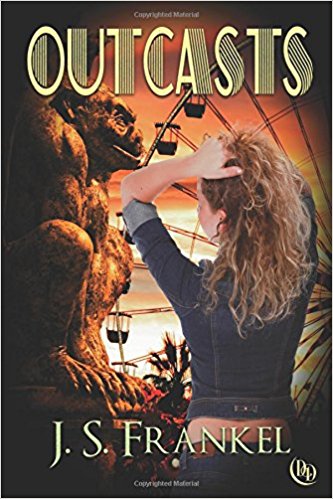
Book Review – Outcasts by J.S. Frankel

It’s not easy to write a book that not only addresses current issues but also entertains.  J.S. Frankel, however, has done exactly that with Outcasts.

Note:  I received a free copy of this book in exchange for an honest review.  I am a participant in the Amazon Services LLC Associates Program, an affiliate advertising program designed to provide a means for us to earn fees by linking to Amazon.com and affiliated sites.  I will always give you my honest opinion on something before linking to it.

From the back cover:  Mitch Kessler, teenage high school dropout, jobless and mostly friendless, lives a life of solitude, but not by choice. Endowed with the ability to bring wings out of his body as well as claws, and transform himself into a fierce creature of the night, he’s picked up a nickname from the general public that he hates: gargoyle. However, that’s the least of his worries. His girlfriend, Callie, can’t keep her genders straight, his best friend is a spinning top, and his other acquaintance is made of rock. It’s obviously a government plot, but Mitch doesn’t know who’s behind it or why. Worse, various and sundry creations have now appeared out of the woodwork and are out to kill him. Aided by his friends, the four outcasts attempt to find out who’s running the show. They’re out to stop the forces of evil before they can do more damage. That is, if they survive.

outcasts

As teen mutants who have yet to figure out their place in the world, the main characters go through quite a bit.  They deal with typical teen issues, which are compounded by the fact that they have superpowers.  To make matters even more difficult, the main character finds himself falling for a person who constantly switches genders.  The gender issue is a big one these days, and I think this makes the book very relevant to today’s youth.  There is gender and sexuality confusion not only for the Callie, who is sometimes a boy and sometimes a girl, but also for Mitch, who has to figure out how he feels about him/her.

The book starts off with action, and we slowly learn more and more over time about Mitch and his friends.  The time frames switch back and forth between the present and the past, but these are clearly labeled to avoid confusion.  Outcasts has a casual tone that I think YA readers would really enjoy:

“Screw getting the football back. We trudged on home. Joe lived ten minutes away from me, very convenient for hanging out with each other. Fact was, we visited each other’s houses on an almost daily occurrence, either playing sports after school or fooling around with video games.”

While there are some sentence structure choices that are a little bit awkward and I feel the book could have been better edited, overall I think this is a great book.  I recommend it for anyone who enjoys modern fantasy and is looking for a fun read.

Rating:  4 stars

* * *

Ashley O’Melia is an independent author and freelancer from Southern Illinois.  She holds her Bachelor’s Degree in Creative Writing and English from Southern New Hampshire University.  Her books include The Wanderer’s Guide to Dragon Keeping and The Graveside DetectiveHer short stories have been published in The Penmen Review, Paradox, and Subcutaneous.  Ashley’s freelance work has spanned numerous genres for clients around the world.  You can find her on Facebook and Amazon.

Interested in having your book reviewed?  Contact me.


1 Comment

Filed under Book Reviews

Book Review: Mayhem at the Orient Express by Kylie Logan

I won this book in a silent auction basket at my local library.  I mean, I had to bid on it since it was nothing but books about cats, right?  I also happen to like cozy mysteries, so this was an easy entry on my To Read list.

The first thing I have to say about Mayhem is that it’s not quite as cozy as other books in the genre that I’ve read.  While I’ve really only gotten into this type of book over the last few years and I can’t say I’ve delved extensively into the genre, I was surprised to find that there were quite a few cuss words.  There’s also the mention of condoms and more than an insinuation that two characters are having sex.  I’m not offended by any of this, but it stood out to me as unusual.

Mayhem is written in first person in a very casual, sarcastic style that I really enjoyed.  Bea Cartwright is sassy and a little crabby, and she doesn’t hesitate to talk about it.  The book is fast-paced and well put together with a good mystery.  The clues and the red herrings are intermixed, keeping the real mystery for the very end.  Along the way, we discover that Bea has a secret of her own, which just adds to the plot.

At the beginning of the book, the main characters have been in court far too many times complaining about each other.  The local judge sentences them to join the library’s book club.  While this seems pretty far-fetched and made for a bit of a bumpy start to the book, it was a good way to draw the characters together.  Things picked up quickly, and then I couldn’t put it down.

As you may have guessed, Murder on the Orient Express is featured in this mystery.  While I think the book would still be enjoyable if you haven’t read Christie’s classic, I think it’s better for having done so.  I just read MOE a few months ago, so a lot of the elements were still fresh in my mind.

Overall, I highly recommend this book.  My one disappointment is that the cat on the cover was only a very minor part of the book, mentioned maybe two or three times.  If you’re expecting a cat mystery, this isn’t it.  But it was a quick, fun read, and I’ll definitely read more by the same author.


If you enjoyed this post, be sure to find me on Facebook or check out my books on Amazon.

Leave a comment

Filed under Book Reviews

Book Review: The Sea House by Elisabeth Gifford

Have you ever read a book that just reached right out and punched you in the heart?  The kind of book that made you stare at it for a while after you finished it, wondering just how your life was going to be different from then on?  Because it had to be different, simply because of that book.

For me, The Sea House by Elisabeth Gifford was one of those books.  I picked it up on a random trip to Barnes & Noble, when I peeked at the bargain rack and immediately snatched it up.  This book practically jumped into my hands and demanded, “Read me!”

The tone of the book very well portrays the loneliness and the magic of living near the sea, combined with the solemn desperation of infertility.  What struck me most was the exploration of sirenomelia, also known as mermaid syndrome.  Having had a daughter born with a cancerous tumor, any plot element around a baby with a birth defect or a miscarriage gets me right away.  I’ll be honest, it didn’t help that my last name is part of the name of the syndrome.  Let’s just say there’s some significant water damage to the pages of this book.

The book switches back and forth between Alexander Ferguson, a vicar and evolutionary scientist in 1860, and Ruth and Michael, who have purchased a house by the sea in the hopes of making it a home for their future family.  They find the bones of a baby with mermaid syndrome under the floorboards, causing Ruth to not only pursue the truth behind the deceased child but behind her own relationship with her mother.

I’ve had The Sea House sitting on the corner of my desk for a while, planning to write a review.  But I was so involved in the reading that I didn’t even make any notes, and I couldn’t think of anything quite sufficient to say about it.  It’s just that good.  It’s unique, it’s haunting, and it thrashed my heart into a hundred pieces.  This volume has earned a permanent place on my shelf.

Thanks for dropping by!  If you liked this post, be sure to subscribe and find me on Facebook.


Leave a comment

Filed under Book Reviews

Book Review: Saturn Run by John Sandford and Ctein

Okay, I know you aren’t supposed to judge a book by its cover, but I completely did.  I mean, just look at this thing.  Every time I went to Barnes & Noble, this book was practically dancing and singing on the shelf, begging me to take it home.

I resisted at first, but that’s pretty much just because I’m a ridiculous tightwad unless I’m buying something for my kids.  Also, I was a little worried that it might be too “heavy.”  It’s about a mission to Saturn, and while I’m not afraid of heavy reading, I’m not always in the mood for it.

It turns out I didn’t have to be.  When I finally decided that I had to buy the book even if it was just so I could look at the pretty cover on my shelf, I discovered a story that was riveting and thrilling while also being very real.  It was surprisingly down-to-Earth for a story about space, and I loved it.

Saturn Run is the story of an urgent flight to Saturn (and a race against the Chinese to get there first) when the possibility of a visit by an alien spaceship is discovered.  You couldn’t possibly tell a story so big from just one viewpoint, so the authors didn’t.  This a character-driven plot, focusing on how the mission affected the different people involved in it.  There are a lot of characters, but they’re all very deep, distinguishable, and memorable.  While the novel outlines the political aspects of space travel, it emphasizes the direct impact on the characters involved.  The viewpoint changes numerous times, even within chapters, but it’s so seamless that it only adds to the story.

Although Saturn Run falls doubtlessly in the category of science fiction, it also just might be creating a new genre of “science really-could-happen-in-the-timeframe-specified.”  The author’s note in the back (which you can’t read until you’ve read the story) shows just how much prep work the authors did for this novel, including plotting orbits and calculating the engine specifics of the starships involved.  While the science is not what we have today, there was nothing as Star Trek-y as a transporter or a tractor beam (although those could have been quite useful to some of the characters).  Sandford and Ctein took current science and advanced it by fifty years without throwing in a lot of magic and fantasy.

I highly recommend this book for anyone interested in science fiction.  I even finished the last third of it with a terrible head cold because I just couldn’t put it down!

***

If you enjoyed this post, be sure to come find me on Facebook and Amazon!

3 Comments

Filed under Book Reviews

Book Review: Go Set a Watchman

I know a lot of people read To Kill a Mockingbird sometime around junior high, but I wasn’t one of them.  Somehow, I missed this one.  Maybe it was because we moved around a little bit, or maybe I had teachers who weren’t interested in it.  I finally read it a few years ago and loved it, so I was excited when I picked up a copy of Go Set a Watchman.

This book has a very similar tone to Mockingbird, somewhere between ideal summer days and the painful smack of real life.  While Mockingbird was a coming-of-age story for a child version of Jean Louis “Scout” Finch, Watchman is a coming-of-age story for her as an adult.  She returns to Maycomb thinking she understands where she has come from now that she’s been living in New York City for a while, but soon comes to realized that you can never go home again:

Hell is eternal apartness.  What had she done that she must spend the rest of her years reaching out with yearning for them, making secret trips to long ago, making no journey to the present?  I am their blood and bones, I have dug in this ground, this is my home.  But I am not their blood, the ground doesn’t care who digs it, I am a stranger at a cocktail party.

It’s the kind of thing that makes the book relatable, because many of us realize eventually that even though we are adults, we aren’t quite grown.

The repeated themes of life in the South, racism, and the importance of family aren’t a surprise, since this book is focused on the same characters as Mockingbird and essentially served as a first draft for the novel that would come to win Harper Lee so many accolades.

What I believe made Lee such a well-known writer was her excellent use of description.  Her word choice could make nothing sound like something and make it seem far more important to the story than it really was:

On any other day she would have stood barefoot on the wet grass listening to the mockingbirds’ early service; she would have pondered over the meaninglessness of silent, austere beauty renewing itself with every sunrise and going ungazed at by half the world.  She would have walked beneath yellow-ringed pines rising to a brilliant eastern sky, and her senses would have succumbed to the joy of the morning.

While nobody can debate that Lee was a talented writer and that she tackled subjects that might make other authors turn toward something a little less realistic, I can’t say this is my favorite book.  There were plenty of times when it was too boring, focusing so much on the character arc that there was little action.  The massive amount of contemporary references–which would require me to stop and look them up on the internet if I truly wanted to understand the point a character was making–made it a bit of a difficult read.  One thing that especially bothered me towards the end of the book was that Dr. Finch and Atticus spoke in very indirect, beat-around-the-bush sort of ways that were more confusing that intriguing.  I didn’t come to this book looking for a light read, and I certainly didn’t find one.

Thanks for stopping by!  If you enjoyed this article, please subscribe or find me on Facebook.


2 Comments

Filed under Book Reviews

Guest Post: Review of Better than Before by Vijay Rajamani

by Vijay Rajamani

Habits shape our existence and future.  Scientists claim that we repeat about 45 percent of our behavior almost daily.

Habits are the invisible architecture of daily life. By changing our habits, we can change our lives. But is it easy to change habits? No.

Gretchen Rubin’s book, Better than Before: Mastering the Habits of our Everyday Lives, addresses the question:  How do we change our habits?

There are numerous categories of books on habits. Most are interesting reads that give you great insights on habits. However, I found some limitations such as:

(a) Many books train you to intellectually appreciate the science or art of habit formation. They talk about how the brain makes neural connections, which parts of the brains are involved in habit formation process, etc. You may not connect well with these if you don’t enjoy authors who don the persona of a professor.

(b) Most don’t consider the role of your own personality in building and sustaining habits. Unfortunately, no one size fits all — especially when it comes to habits.

(c) Some try to tell you the best habits to build, which may not resonate with your own ideas of good habits.

(d) Few others get in to research findings and reel out statistics of behavioural experiments, which are insightful for academic discussions, but may not be easy to adopt in your own life.

These make you treat the science of habits as an intellectual read, rather than something easy enough to try out yourself and make remarkable changes.

However, Gretchen Rubin’s Better than Before is a refreshingly different take on habit formation and change. “Better than before” is a transformational state that we all seek to achieve.

An epiphany that Gretchen had during a chance conversation with a friend is the starting point of this book. Her friend struggles with sustaining her exercise habit post-marriage.

That gets Gretchen to ponder over many interesting questions about habits, such as:  It is understandable why it’s hard to form a habit we don’t enjoy, but why is it hard to form a habit we do enjoy? Why is it that sometimes people acquire habits overnight, and sometimes they drop longtime habits just as abruptly?

Gretchen’s sister Elizabeth, nudges her to be a guinea pig herself (Gretchen) to try out various habit formation, habit change strategies, and share her insights to the world. Gretchen picks up the challenge and the result is Better than Before.

Gretchen divides the book in to 5 sections.

Section I: “Self-Knowledge,” explores the two strategies that help us to understand ourselves.

Gretchen ties habit formation to your personality type. Gretchen divides humans in to 4 personality types (or tendencies), based on how one meets (or doesn’t meet) internal and external expectations. (1) Upholder (meet both internal and external expectations) (2) Obliger (meets external but not internal expectations) (3) Questioner (meets internal but not external expectations) and (4) Rebel (meets neither external nor internal expectations). If you are interested in taking her quiz to find out your tendency, here’s the link.

This is a game-changing insight because each personality type has a different worldview and different ways of solving problems. What works for one type may not work for another. You need to understand what type you are and adopt different strategies based on your personality type.

Forinstance if you are a questioner, you won’t do anything unless you have convinced yourself that a habit is of value before you pick it up. If you try to start a habit before you have passed that test, you are setting yourself up for failure.

Similarly, if you are an obliger you need someone that you are accountable for. If you don’t find yourself accountable to anything or anyone for a habit, then you may not be successful at that. She also underlines certain other personality differences such as lark vs. owl and sprinter vs marathoner that greatly influence how we form habits.

Section II: “Pillars of Habits,” examines the strategies of Monitoring, Foundation, Scheduling, and Accountability.

As for monitoring, Gretchen talks about her experiences with monitoring her health using fitness bots, and how it helped her use the data to get insights to change habits.

She talks about the foundational habits of sleep, eating and drinking right, and uncluttering, and how she tried to embrace them.

In scheduling, she describes her experience of trying to schedule things, and offers helpful suggestions on how you can be smart about them if you factor in your personality types (such as owls vs. larks).

Using accountability as a strategy, she argues that you can strengthen your habit-building if you make yourself accountable to someone (even yourself) for your actions. That improves your self-command.

Section III: “The Best Time to Begin” considers the importance of the time of beginning when forming a habit, as explored in the strategies of First Steps, Clean Slate, and Lightning Bolt.

Section IV: “Desire, Ease, and Excuses” considers our desires to avoid effort and experience pleasure—which play a role in the strategies of Abstaining, Convenience, Inconvenience, Safeguards, Loophole-Spotting, Distraction, Reward, Treats, and Pairing.

Section V: “Unique, Just like Everyone Else” investigates the strategies that arise from our drive to understand and define ourselves in the context of other people, in the strategies of Clarity, Identity, and Other People.

Gretchen writes most of the book in first person, talking about her own struggles in picking up habits and how she goes about approaching them. She also narrates how she influences her friends and family with these strategies and documents their success or failure with those strategies. These are almost in story format, so your attention is certainly hooked.

I could feel totally connected with the way she narrates her strategies and experiments. Each sentence in the book is packed with wisdom. These stem from Gretchen’s own experiences, as well as the research material that she has gone through in arriving at these conclusions (if you read through the appendix).

Gretchen has taken care not to bore you through all the statistics and to keep it interesting. She makes the point that if something works for you, it is as significant or more significant than the insights from research and data.

The way she has interspersed some of her “Secrets of Adulthood” as part of the habit-formation strategies, blends naturally and enhances the narrative. The one I particularly liked was “What I do every day matters more than what I do once in a while.”

The book takes a human view of habit formation. It talks about potential traps that you may face and what you can do about them.

It doesn’t offer iron-clad guarantees on what strategies will stick and what will not. It depends on you and your tendency. This is not also a prescriptive attempt to define what habits are right for you.

Think of it as a catalogue of strategies that Gretchen picked to try certain habits, and her experiences with those.

Most of the strategies are so simple that you can adopt them very easily and quickly. It is totally up to you to decide and adopt the habits that are important to you, and the strategy you think will work best for you.

You may not particularly enjoy this book: (a) If you want a more analytical narrative that focuses more on research findings, data, graphs and ties everything back to the statements; (b) If you want the organization of the book to be bulletized list of things to do; (c) If you need a list of actions or habits all outlined clearly for you to extract the summary; (d) If you think first-person narrative of personal experiences is not conducive to a subject like this.

I found this book to be a fascinating read. The narrative is simple, concise, and well-organized. No wonder it is a NY Times bestseller.

I am actively trying out some of the strategies (like scheduling, monitoring etc.). I find that some strategies work and some don’t. I hope you find it enjoyable too.

This article is by Vijay Rajamani, a blogger based out of Bangalore, India. He is a productivity enthusiast, who writes about Productivity topics in his blog My Productivity Lab.

Leave a comment

Filed under Book Reviews, Guest Posts

Book Review: Five Weeks in a Balloon by Jules Verne

It’s not often that I have a cold, rainy Saturday with nothing to do.  Oh sure, there are plenty of things I could have done, but since I didn’t have to I decided to finish this book.

Five Weeks in a Balloon is the first in a collection of seven novels in this gorgeous volume I picked up at Barnes and Noble a few months ago.  The tale follows Dr. Ferguson, Dick Kennedy, and the faithful Joe Wilson as they traverse Africa in a balloon, attempting to investigate the depths of the continent that have up until that point been unreachable by other explorers traveling on the ground.

Verne, as always, did a fantastic job with his description.  As the trio explores vast landscapes, battles dangerous animals, and fights the elements, the reader is easily pulled into every scene.  They say that as a writer you have to learn how to torture your characters in order to make a good story, and that most certainly happens in this novel.  The characters are almost constantly in danger of some sort, just barely pulling free before it’s too late.  One of my favorite examples of this is when the men in the balloon pull a man from his horse to safety as he’s being pursued by a group of angry horsemen.

A tale of exploration, peril, and constant adventure, I recommend Five Weeks in a Balloon to anyone looking for a little excitement.  I would also suggest that the reader keep in mind the fact that this book was published in 1863, so the rather Eurocentric viewpoint is a manifestation of its time in history.

Be sure to find me on Facebook!

Leave a comment

Filed under Book Reviews

Insecure About Your Writing? I Don’t Doubt It.

I always like making new writing and blogging friends.  In a recent conversation with a new acquaintance, he asked me if you ever get over the “debilitating self-doubt” that comes with writing.

Nope.

I knew that was the answer, but I discovered just how true that was as I prepared to launch my latest book.

Although I’m an indie author, most of my writing happens on the freelance scene.  I have consistent work creating blogs and ghostwriting, and this means that I usually spend a lot more time doing the projects that make me a little cash than the ones that are simply for my own creative pleasure.  I do have quite a few stories waiting to be written, though, so I took the day off from my “regular” work to get my book finished up and ready for release.

By the time I release a book on the world, I’m absolutely sick of it.  I have read this current book so many times that I just can’t stand it any more, and that’s how I know I’m done.  There is nothing more that I can do to change it or make it better.  It is as complete as a book can be.

Even though I knew the book was done, that knowledge didn’t stop a shocking amount of fear and anxiety from creeping up on me as I created a Facebook event and sketched out my marketing ideas.  I thought at first that I was just frustrated; it’s difficult to know what the “right” thing is to do when it comes to promoting your work.  I had a couple of close friends that attempted to help me, but they just couldn’t.  I was an absolute mess.

Eventually, I calmed down and got over it.  I got past the mental block that my anxiety had caused and was able to think creatively again.  I’m good now.

But I want everyone out there who doubts their skill as a writer to understand that you aren’t alone.  Writing is a job that not only takes a lot of hard work but also a lot of bravery.  It’s impossible to write without putting a little bit of yourself into that book, and you’re opening it up for everyone to see it.

It’s tough, but you can do it.


Feel free to come drop a like on my Facebook page!


10 Comments

Filed under Book Reviews, Books, On Writing

Come Join My Book Release Party!

t’s been almost two years since I released The Wanderer’s Guide to Dragon Keeping, and it’s finally time for the sequel!  Come join my release party for giveaways, the cover reveal,  and other fun!  The best part is that you can do it all in the comfort of your home.

Fun dragon


Leave a comment

Filed under Book Reviews, Books, On Writing, Uncategorized

A Review of Out of Time by Monique Martin

I truly believe that you should read in the genre in which you want to write.  My most recent foray into this principle concerns time travel.  Once I finish up the sequel to The Wanderer’s Guide to Dragon Keeping, I have an outline that I’ve started for something a little different.  I don’t have a title for it yet, but it’s based on a dream I had once and revolves around (you guessed it) time travel.

During a quick little shopping trip to Amazon, I found Monique Martin’s Out of Time.  Since I always try to support other indie authors and it had good reviews, I decided to download it.  I haven’t regretted it.

51CiNxJxEaL__SX331_BO1,204,203,200_

Elizabeth and Simon find themselves transported to 1920’s Manhattan.  While they search for a way back to their own time and place, they have to face some major challenges.  Not only do they have to blend into this new world, but there are vampires to fight as well.

The characters are well developed and experience genuine arcs as the plot progresses.  Martin lets the reader into the minds of both of the main characters throughout, bringing their emotions right to the forefront of the story.  Martin fully employs her descriptive powers, whether she is letting us in on the in’s and out’s of what life was like in the 1920’s or simply waxing literary.  One of my favorite lines from the book:  “Umbrellas blossomed like black flowers in a potter’s field.”

I noticed that another reviewer on Amazon stated that the vampires seemed to come out of nowhere in the story and were a bit misplaced.  I humbly disagree.  I think the problem is simply that Ms. Martin plunges the reader so thoroughly into the time period of the story, that the reader forgets what the book is actually supposed to be about.  It’s a rare occasion that the author does such a good job that we forget what’s going on.

I highly recommend Out of Time to anyone looking for a great sci-fi romance! I look forward to reading further into this series!

3 Comments

Filed under Book Reviews, Books