Book Review: Saturn Run by John Sandford and Ctein

Okay, I know you aren’t supposed to judge a book by its cover, but I completely did.  I mean, just look at this thing.  Every time I went to Barnes & Noble, this book was practically dancing and singing on the shelf, begging me to take it home.

I resisted at first, but that’s pretty much just because I’m a ridiculous tightwad unless I’m buying something for my kids.  Also, I was a little worried that it might be too “heavy.”  It’s about a mission to Saturn, and while I’m not afraid of heavy reading, I’m not always in the mood for it.

It turns out I didn’t have to be.  When I finally decided that I had to buy the book even if it was just so I could look at the pretty cover on my shelf, I discovered a story that was riveting and thrilling while also being very real.  It was surprisingly down-to-Earth for a story about space, and I loved it.

Saturn Run is the story of an urgent flight to Saturn (and a race against the Chinese to get there first) when the possibility of a visit by an alien spaceship is discovered.  You couldn’t possibly tell a story so big from just one viewpoint, so the authors didn’t.  This a character-driven plot, focusing on how the mission affected the different people involved in it.  There are a lot of characters, but they’re all very deep, distinguishable, and memorable.  While the novel outlines the political aspects of space travel, it emphasizes the direct impact on the characters involved.  The viewpoint changes numerous times, even within chapters, but it’s so seamless that it only adds to the story.

Although Saturn Run falls doubtlessly in the category of science fiction, it also just might be creating a new genre of “science really-could-happen-in-the-timeframe-specified.”  The author’s note in the back (which you can’t read until you’ve read the story) shows just how much prep work the authors did for this novel, including plotting orbits and calculating the engine specifics of the starships involved.  While the science is not what we have today, there was nothing as Star Trek-y as a transporter or a tractor beam (although those could have been quite useful to some of the characters).  Sandford and Ctein took current science and advanced it by fifty years without throwing in a lot of magic and fantasy.

I highly recommend this book for anyone interested in science fiction.  I even finished the last third of it with a terrible head cold because I just couldn’t put it down!

***

If you enjoyed this post, be sure to come find me on Facebook and Amazon!

3 Comments

Filed under Book Reviews

Book Review: Go Set a Watchman

I know a lot of people read To Kill a Mockingbird sometime around junior high, but I wasn’t one of them.  Somehow, I missed this one.  Maybe it was because we moved around a little bit, or maybe I had teachers who weren’t interested in it.  I finally read it a few years ago and loved it, so I was excited when I picked up a copy of Go Set a Watchman.

This book has a very similar tone to Mockingbird, somewhere between ideal summer days and the painful smack of real life.  While Mockingbird was a coming-of-age story for a child version of Jean Louis “Scout” Finch, Watchman is a coming-of-age story for her as an adult.  She returns to Maycomb thinking she understands where she has come from now that she’s been living in New York City for a while, but soon comes to realized that you can never go home again:

Hell is eternal apartness.  What had she done that she must spend the rest of her years reaching out with yearning for them, making secret trips to long ago, making no journey to the present?  I am their blood and bones, I have dug in this ground, this is my home.  But I am not their blood, the ground doesn’t care who digs it, I am a stranger at a cocktail party.

It’s the kind of thing that makes the book relatable, because many of us realize eventually that even though we are adults, we aren’t quite grown.

The repeated themes of life in the South, racism, and the importance of family aren’t a surprise, since this book is focused on the same characters as Mockingbird and essentially served as a first draft for the novel that would come to win Harper Lee so many accolades.

What I believe made Lee such a well-known writer was her excellent use of description.  Her word choice could make nothing sound like something and make it seem far more important to the story than it really was:

On any other day she would have stood barefoot on the wet grass listening to the mockingbirds’ early service; she would have pondered over the meaninglessness of silent, austere beauty renewing itself with every sunrise and going ungazed at by half the world.  She would have walked beneath yellow-ringed pines rising to a brilliant eastern sky, and her senses would have succumbed to the joy of the morning.

While nobody can debate that Lee was a talented writer and that she tackled subjects that might make other authors turn toward something a little less realistic, I can’t say this is my favorite book.  There were plenty of times when it was too boring, focusing so much on the character arc that there was little action.  The massive amount of contemporary references–which would require me to stop and look them up on the internet if I truly wanted to understand the point a character was making–made it a bit of a difficult read.  One thing that especially bothered me towards the end of the book was that Dr. Finch and Atticus spoke in very indirect, beat-around-the-bush sort of ways that were more confusing that intriguing.  I didn’t come to this book looking for a light read, and I certainly didn’t find one.

Thanks for stopping by!  If you enjoyed this article, please subscribe or find me on Facebook.


2 Comments

Filed under Book Reviews

Author Interview: Carlos LoPopolo

There’s nothing better than a good children’s book, unless it’s one that is based on real life.  That’s the case with Zobo:  The First Mustang, the first in a series of books that follows the real history of the mustang in America.

              Zobo with his mother, Rain

I see you’ve established two wild horse preserves in New Mexico, and you’re working on starting another one in Texas.  Where did your passion for horses come from?

I’ve always been around horses since I was seven, but in ‘99 when I found out what was happening to the mustang it became important to understand their plight and help to preserve them for future generations.  It was on their back this country this country was built.

It’s quite a process to produce a picture book.  What’s the toughest part?

Finding an artist that understands your concept.

                    Zobo’s father, Sombrillo

What does the future hold for Zobo?  Will there be more books coming?

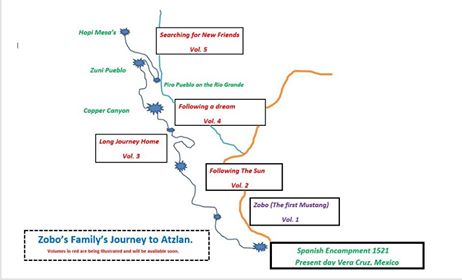
Zobo is the first generation. The series brings the lineage forward from the area of present day Vera Cruz, Mexico to the government preserve they graze on today.  I am presently working on the eighth book in the series and the tenth line of Zobo’s descendants.

How long have you been writing?

Since I was in a kid but didn’t get serious until I was in high school.


Who are your favorite authors?

Thurber, Diaz, Castaneda. I like this quote from Castaneda: The trick is in what one emphasizes. We either make ourselves miserable, or we make ourselves happy. The amount of work is the same.

The path Zobo and his family would have taken.

What are you reading right now?

Historical documents from New Mexico, Texas, and Mexico.

Bio:  Pam and Carlos live in Bastrop Texas on a little parcel of land with their friends; three dogs, Bob, Mindy, and Trish, two cats Molly and Terry, three chickens (the chickens all look alike so they are hard to name), two donkeys, Bella and Storm, and two horses, Bliss, and Crackers. They all live together in harmony most of the time but, sometimes in chaos.  When they are not enjoying the bright sunshine of Central Texas or the fantastic sunsets they are thinking about where Zobo’s descendants are going next.   Since 1999 Carlos has been rounding up and preserving wild horses.  He has established two wild horse preserves in New Mexico.   Together with his wife Pam they are trying to raise enough money to purchase land here in Texas to open up another wild horse preserve. They are not asking for donations, which is why they are writing the Zobo series.  Through the sale of the books and the development of the movie project,  they hope to raise enough money to purchase land for a new preserve.


1 Comment

Filed under Animals, Author Interviews

Author Interview – Rachel De La Fuente

With her book, The Most Special Chosen, out this weekend, I got a chance to chat with Rachel De La Fuente about books, writing, and our addictions-in-common.  Make sure to check out her release party on Facebook as well!

Tell us a little bit about your new book, The Most Special Chosen.

The Most Special Chosen is about a seemingly normal, though somewhat vampire obsessed, college student, Elysabeth Vance; her best friend of 8 years, Shawn Dooley; and her sexy new boyfriend, Damien. Damien draws Elysabeth like a moth to a flame, but practically repulses Shawn, literally making his hair stand on end.

Shawn is concerned about their relationship, but Elysabeth’s intuition, the little voice that has been guiding her throughout her life, convinces her that all is well. With a little help from Damien and his family, Elysabeth will uncover her powerful bloodline and unlock her destiny. After all, fate happens, even if you don’t believe in it.

What more do you have planned for the Exalted Bloodline series?

The currently planned story arc includes 6 books. That could increase if any of the books get too long. For example, when I started writing the second book, it included book 3, but the manuscript got too long, so I separated them.

Book 2 is currently about 1/2 – 2/3 done. I have to go back and make some changes after the editing I’ve done on The Most Special Chosen, and then I can work on finishing it.

I also have an ongoing commission with artist Kyle McGill, a friend of mine from college. He’s creating portraits of all of my main characters. I’ve featured his work in each of my character interviews.

The best way to keep up on future Exalted Bloodlines Series news is to subscribe to my blog or newsletter.

I see that you’re a fountain pen enthusiast (something I’m guilty of myself). Do you prefer a certain brand of pens or ink?

Yay! Another person afflicted (or blessed, depending on your point of view) with the fountain pen virus. 😀  Fountain pens are so much fun, and write so smoothly.

I have a particular affinity for visually arresting pens, especially brightly colored ones. New pens are always coming on the market, so it’s nearly impossible to say that any one brand has the prettiest pens.

As far as ease, my favorites are Lamy Safari and Pilot Metropolitan. No matter how long I leave those pens without writing, I can come back, pick one up, and it will just start writing again. It’s fabulous.

For writing quality, of the pens I own, the smoothest pen is my Pineider Key of Heaven. But it’s an EXPENSIVE pen, so I would expect it to be fabulous. I wouldn’t have picked it up if I wasn’t offered a fabulous deal. And the store let me try writing with it, which completely sold me on the pen.

Favorite ink brand…that’s even harder. I’m going to go with the easiest metric. Of my currently inked pens, the most utilized brand is Diamine. But Pilot Iroshizuku and Organics Studio are high on my list as well. And my fiancé loves Robert Oster.

Sorry for the long response. I get a little carried away with fountain pens and ink. I don’t have a problem…really…

I’m thrilled to see that you love to cross stitch! (Are we related or something??) What’s your favorite piece that you’ve done?

My family tree is spread so wide, we could be. J I’ve only finished a few pieces, and I have one massive one in the works.

My favorite finished work is one featuring two sleeping kittens in a windowsill. I stitched it as a thank you gift to my cousin for paying for some life-saving vet care for my male cat. I couldn’t afford it at the time. The kittens happened to match the coloring of my two cats almost exactly. To finish the piece, I framed it with a mat where I added my cats’ paw prints. My cousin still has it up on a bookshelf in her living room.

My in-progress piece is an enormous Harry Potter piece based on the Giant sampler available through CloudsFactory. I made a bunch of edits and separated the characters and objects by books. But now it’s around 3′ x 4′. Who know when I’ll actually get a chance to finish it.

What’s your writing process like?

That’s a little hard to say. The Most Special Chosen is my first novel, but it’s been a nearly 8-year journey to get it to this publication, and that’s only in this iteration.

Recently, I’ve noticed that my writing has been changing. I have an outline of sorts for book 2, whereas I didn’t for book one. I feel like I’m more aware of my writing, too. I’m more careful in my word choices and how I present my characters. I also do a better job of maintaining my characters’ individual voices. I’m hoping this means less editing for book 2, because I really don’t want to take another 8 years.

But there are also things that have stayed the same. I still write in a non-linear fashion. Sometimes things come to me, and I have to jot them down. Then I can go back and work them into the story. I also still write, then read over what I’ve written repeatedly, revising as I go.

One thing I wish I could get a hang of is writing to a daily quota. I don’t know how people do it. I write when I feel inspired, because otherwise, whatever I write is complete crap. More often than not, when I force myself to write, I end up simply deleting everything.

But, on the up side, when I write while inspired, it typically flows very easily, to the point where I can write several thousand words in a sitting.

Do you have any advice for other writers?

Just keep writing. It sounds silly, I suppose, but if you really enjoy writing, if you really want your writing to go somewhere. Just keep at it. Some of my friends read The Most Special Chosen when it was self-published, and then went on to read the beginning of book two several years later. They noticed a significant improvement in my writing, and I wasn’t even “trying” to improve. It just happens with practice.

Also, read as much as you can. Really study the books you like. Pay attention to the details. Take note of the way characters interact, how settings are described. And don’t disregard the bad books either. You can learn a lot from them as well. As you learn what does and doesn’t work, you can refine your own writing style.

Scroll down for an excerpt for The Most Special Chosen, or you can find the entire first chapter on her website.  You can also visit Rachel on Facebook or order her book on Amazon.

  * * *

It takes every ounce of my self-control to not slam my books down on the table as I reach Shawn. To avoid getting thrown out of the library, I plonk them down lightly and drop into a chair with a sigh.

“Bad day?” whispers Shawn, my best friend of eight years. “I thought it was supposed to be great.”

I schlump forward and rest my chin on my hand. “It was supposed to be, according to my intuition. That’s why I dressed nicely.” I gesture vaguely to my outfit with my free hand. I have on a pair of black, knee-high, leather boots; black leggings; and a lightweight, crimson sweater dress that accentuates my curvy figure. I only wear a little makeup to set off my brown, almond-shaped eyes. I’ve left my copper-colored hair long and wavy, hanging to my hips.

“The only thing special about today is that I’ve been rather hot.” I pull my hair up and shake it as I speak, coaxing some air to my neck. “Southern California isn’t particularly cold in November.”

“I thought you said your intuition is never wrong.”

“It’s not, I just…” I shrug, unsure how to finish that sentence. My intuition hasn’t been wrong once in my entire life, and ignoring it has always been to my detriment. I can’t understand how it’s suddenly wrong.

Shawn leans forward to touch my hand. “Maybe your something special is still to come. The day isn’t over yet.”

I shrug again and watch as he goes back to his studying. He hasn’t changed much since high school. His soft, dirty-blonde hair hangs to his ears; huge, horn-rimmed glasses hide his startling green eyes; and his nose is a little too big for his face. He’s not ugly, but he’s no model, either.

Look up.

My intuition, the same strange whisper I’ve heard at various points in my life, speaks again. I obey instantly. Perhaps this is the something special I’ve been waiting for. I catch sight of the most gorgeous guy I’ve ever seen around the many bookcases and quickly sit up straight. He’s perfect! Imagine if he’s — No, Lys. My movement catches Shawn’s eye. He peers over his shoulder, following my line of sight, then turns back, rolling his eyes.

“What is it with you and guys in black?” he says, “Especially ones that look like —”

My sharp look shuts him up. He knows better than to discuss that in public. But I have to admit he has a point. I glance back at Mr. Gorgeous. He does look like — Dammit Lys! They don’t exist. I try not to stare and fail miserably. He has shoulder-length, jet-black hair that looks almost blue in the light; large, ice-blue eyes; full and sensual yet masculine lips; a square jaw that somehow doesn’t look chiseled; a mustache that grows into a short goatee; and lovely, olive skin.

He rounds the last bookcase and I can see he’s wearing a black, form-fitting shirt that hints at washboard abs; black leather pants; a floor-length, black, leather, trench coat that accentuates his broad shoulders; and combat boots. He must be at least six feet tall and he walks with a deadly purpose. He’s exactly what I’ve always imagined. Everything about him screams dangerous; and the effect is mesmerizing.

He’s obviously looking for something — or someone. Probably a girlfriend. I’m still ogling him when his gaze suddenly meets mine. I see a brief flash of recognition, but I know I’ve never seen him before. His eyes dart down and back up, and I have an irrational desire to pull my neckline down a bit. His grin is sinful. It promises wicked things, and I want to find out exactly what they are. I drop my gaze to Shawn who’s making kissy faces at me. My glare could freeze fire. Shawn stops.

The guy walks up and stops next to me. “Hello.”

Oh, holy mother! His voice is deep and sensual and envelops me, sending shivers down my spine. I look up at him and become enraptured by his smile. It takes a moment, but I finally manage to speak. “Hi, can I help you?”

“Not exactly. I merely wondered if I may sit with you.” I can’t quite place his accent. It’s French, but there’s something else there, too, and it runs right through me like fire, pooling low in my belly. What the hell, Lys? This is not a normal reaction for me.

I glance at Shawn who nods reluctantly, knowing I’ll say yes either way. “Yes, of course. Are you new? I don’t believe I’ve seen you before.” Idiot! I mentally kick myself. It’s a huge campus, and I don’t know everyone.

He fluidly takes a seat, and I take in his perfect posture. It certainly doesn’t go with the way he looks.

“Actually, I have been taking classes online. I decided that since I will be graduating soon, I should get to know some of the other students and start networking.”

I nod. “Yeah, definitely a good idea. What’s your major?”

“International Relations and Diplomacy, and International Business.” Wow, double major. Must be smart, and obviously ambitious. “And yourself?”

“Architecture and Interior Design. My mom’s always said I have an eye for detail, and I like doing it. The money’s not bad either…” I don’t know why I feel the need to explain myself, but my major suddenly seems frivolous.

He smiles. “It is good you chose to do something you are passionate about,” he then looks to Shawn. “And what are you studying?”

“Advanced mathematics. I’d like to be a college professor.” I grin at the defiant way Shawn speaks. His father wanted, still wants, him to go into business and follow in his footsteps. Shawn, however, has other ideas.

“That is admirable. I do not have patience for such mathematics,” he looks down as though embarrassed, then glances back up at Shawn. “But I have a great respect for those who do.”

His response, spoken without any hint of sarcasm or derision, disarms Shawn. “Oh, uh, thanks…”

“Forgive me, where are my manners? I am Damien Delanciennes,” he says, dipping his head like he’s bowing. How odd.

“Interesting name,” grumbles Shawn. I shoot him a dirty look. “I’m Shawn, Shawn Dooley.” He offers Damien his hand, and they shake.

“It is nice to meet you, Shawn. And you, Chérie? I am certain your name is as beautiful as you.” Perhaps it’s because I’m hit by the full force of his blue eyes, but despite having just met, his endearment doesn’t sound odd, nor does the line sound cheesy.

“I’m Elysabeth Vance.” I hold out my hand to shake his, but instead, he takes it lightly and raises it to his lips. He brushes a soft kiss against my knuckles, staring straight into my eyes as he does so and my stomach flips over. Holy crap! I feel all fluttery. His actions don’t match his appearance in the least, and I love it.

“I am very pleased to meet you. You have a lovely name. It references beauty and greatness.”

My face heats. “Thanks. Your name is… elegant.”

He nods his thanks. Damien turns suddenly to face Shawn and sees his frown. “Forgive me, have I given offense? Are you… together?”

Before Shawn can answer, I make sure to set the record straight. “No! No, we’re friends. Shawn has been my best friend since freshman year in high school.”

His look of concern vanishes. “Friendships like that are special.”

I grin at Shawn. “They are.”

It’s quickly becoming apparent I won’t be getting any schoolwork done tonight. Good thing I know the material well. I take a quick glance at the clock and confirm what I’d already suspected.

Damien follows my glance. “I am sorry, am I detaining you?”

“No, not at all, but the library will only be open another ten minutes. I won’t get much done in that time.”

“My apologies, I have kept you from your studies.”

“Oh, no, it’s okay. I don’t have much homework.” I reluctantly gather my things and stand. I don’t really want to go. I want stay and talk to this gorgeous guy. “It was really nice to meet you, Damien.”

He places a hand on my arm to keep me from leaving. “Perhaps, if you are not too busy, you would allow me to buy you a coffee?” Yes! I do a little victory dance in my head.

I see doubt and even worry in Shawn’s eyes when I glance at him, and it makes me pause. I don’t know this guy. It probably isn’t smart to go anywhere with him no matter how gorgeous he is. Maybe I should give it a pass.

Go.

Well, my intuition knows best. I’m certainly not going to argue this suggestion. “If we can go somewhere with hot chocolate, I’m in.” Damien looks almost relieved at my answer. “But I have to be up early in the morning, so it will have to be quick.”

“That is acceptable.” There’s a hint of disappointment in his eyes. “Thank you for joining me. Shawn,” he turns to my best friend. “Would you care to join us as well?”

With Damien’s attention elsewhere, I shake my head emphatically with a pleading expression. It’s easy to tell that Shawn isn’t happy about it, but he gives in. “No, thanks. I actually do need to study. Lys, I’ll see you when you get home.”

I sigh. He just HAD to get in a parting shot. Damien is looking between us, obviously confused. I do my best to set him at ease. “We’re roommates. We share a townhouse. But we’re only friends, really.”

He relaxes. “I see. Shall we go then, Elysabeth?”

“Yeah. I’ll follow you to your car. Shawn drove this morning.”

* * *

If you enjoyed this interview, be sure to follow my blog and come find me on Facebook.


Leave a comment

Filed under Author Interviews

Guest Post: Review of Better than Before by Vijay Rajamani

by Vijay Rajamani

Habits shape our existence and future.  Scientists claim that we repeat about 45 percent of our behavior almost daily.

Habits are the invisible architecture of daily life. By changing our habits, we can change our lives. But is it easy to change habits? No.

Gretchen Rubin’s book, Better than Before: Mastering the Habits of our Everyday Lives, addresses the question:  How do we change our habits?

There are numerous categories of books on habits. Most are interesting reads that give you great insights on habits. However, I found some limitations such as:

(a) Many books train you to intellectually appreciate the science or art of habit formation. They talk about how the brain makes neural connections, which parts of the brains are involved in habit formation process, etc. You may not connect well with these if you don’t enjoy authors who don the persona of a professor.

(b) Most don’t consider the role of your own personality in building and sustaining habits. Unfortunately, no one size fits all — especially when it comes to habits.

(c) Some try to tell you the best habits to build, which may not resonate with your own ideas of good habits.

(d) Few others get in to research findings and reel out statistics of behavioural experiments, which are insightful for academic discussions, but may not be easy to adopt in your own life.

These make you treat the science of habits as an intellectual read, rather than something easy enough to try out yourself and make remarkable changes.

However, Gretchen Rubin’s Better than Before is a refreshingly different take on habit formation and change. “Better than before” is a transformational state that we all seek to achieve.

An epiphany that Gretchen had during a chance conversation with a friend is the starting point of this book. Her friend struggles with sustaining her exercise habit post-marriage.

That gets Gretchen to ponder over many interesting questions about habits, such as:  It is understandable why it’s hard to form a habit we don’t enjoy, but why is it hard to form a habit we do enjoy? Why is it that sometimes people acquire habits overnight, and sometimes they drop longtime habits just as abruptly?

Gretchen’s sister Elizabeth, nudges her to be a guinea pig herself (Gretchen) to try out various habit formation, habit change strategies, and share her insights to the world. Gretchen picks up the challenge and the result is Better than Before.

Gretchen divides the book in to 5 sections.

Section I: “Self-Knowledge,” explores the two strategies that help us to understand ourselves.

Gretchen ties habit formation to your personality type. Gretchen divides humans in to 4 personality types (or tendencies), based on how one meets (or doesn’t meet) internal and external expectations. (1) Upholder (meet both internal and external expectations) (2) Obliger (meets external but not internal expectations) (3) Questioner (meets internal but not external expectations) and (4) Rebel (meets neither external nor internal expectations). If you are interested in taking her quiz to find out your tendency, here’s the link.

This is a game-changing insight because each personality type has a different worldview and different ways of solving problems. What works for one type may not work for another. You need to understand what type you are and adopt different strategies based on your personality type.

Forinstance if you are a questioner, you won’t do anything unless you have convinced yourself that a habit is of value before you pick it up. If you try to start a habit before you have passed that test, you are setting yourself up for failure.

Similarly, if you are an obliger you need someone that you are accountable for. If you don’t find yourself accountable to anything or anyone for a habit, then you may not be successful at that. She also underlines certain other personality differences such as lark vs. owl and sprinter vs marathoner that greatly influence how we form habits.

Section II: “Pillars of Habits,” examines the strategies of Monitoring, Foundation, Scheduling, and Accountability.

As for monitoring, Gretchen talks about her experiences with monitoring her health using fitness bots, and how it helped her use the data to get insights to change habits.

She talks about the foundational habits of sleep, eating and drinking right, and uncluttering, and how she tried to embrace them.

In scheduling, she describes her experience of trying to schedule things, and offers helpful suggestions on how you can be smart about them if you factor in your personality types (such as owls vs. larks).

Using accountability as a strategy, she argues that you can strengthen your habit-building if you make yourself accountable to someone (even yourself) for your actions. That improves your self-command.

Section III: “The Best Time to Begin” considers the importance of the time of beginning when forming a habit, as explored in the strategies of First Steps, Clean Slate, and Lightning Bolt.

Section IV: “Desire, Ease, and Excuses” considers our desires to avoid effort and experience pleasure—which play a role in the strategies of Abstaining, Convenience, Inconvenience, Safeguards, Loophole-Spotting, Distraction, Reward, Treats, and Pairing.

Section V: “Unique, Just like Everyone Else” investigates the strategies that arise from our drive to understand and define ourselves in the context of other people, in the strategies of Clarity, Identity, and Other People.

Gretchen writes most of the book in first person, talking about her own struggles in picking up habits and how she goes about approaching them. She also narrates how she influences her friends and family with these strategies and documents their success or failure with those strategies. These are almost in story format, so your attention is certainly hooked.

I could feel totally connected with the way she narrates her strategies and experiments. Each sentence in the book is packed with wisdom. These stem from Gretchen’s own experiences, as well as the research material that she has gone through in arriving at these conclusions (if you read through the appendix).

Gretchen has taken care not to bore you through all the statistics and to keep it interesting. She makes the point that if something works for you, it is as significant or more significant than the insights from research and data.

The way she has interspersed some of her “Secrets of Adulthood” as part of the habit-formation strategies, blends naturally and enhances the narrative. The one I particularly liked was “What I do every day matters more than what I do once in a while.”

The book takes a human view of habit formation. It talks about potential traps that you may face and what you can do about them.

It doesn’t offer iron-clad guarantees on what strategies will stick and what will not. It depends on you and your tendency. This is not also a prescriptive attempt to define what habits are right for you.

Think of it as a catalogue of strategies that Gretchen picked to try certain habits, and her experiences with those.

Most of the strategies are so simple that you can adopt them very easily and quickly. It is totally up to you to decide and adopt the habits that are important to you, and the strategy you think will work best for you.

You may not particularly enjoy this book: (a) If you want a more analytical narrative that focuses more on research findings, data, graphs and ties everything back to the statements; (b) If you want the organization of the book to be bulletized list of things to do; (c) If you need a list of actions or habits all outlined clearly for you to extract the summary; (d) If you think first-person narrative of personal experiences is not conducive to a subject like this.

I found this book to be a fascinating read. The narrative is simple, concise, and well-organized. No wonder it is a NY Times bestseller.

I am actively trying out some of the strategies (like scheduling, monitoring etc.). I find that some strategies work and some don’t. I hope you find it enjoyable too.

This article is by Vijay Rajamani, a blogger based out of Bangalore, India. He is a productivity enthusiast, who writes about Productivity topics in his blog My Productivity Lab.

Leave a comment

Filed under Book Reviews, Guest Posts

Author Interview: Catherine Bannon

Having lived both in Canada and the US, Catherine Bannon gives a unique perspective to experiencing two different worlds.  She has used this understanding in her writing, and I got the chance to chat with her about that.

I see that you were born in Canada but live in the U.S.  What do you miss most about Canada?

I’ll be honest, I’m not sure how best to answer that. I was eleven when we moved to the US because of my father’s work, so my memories are those of a child and I’m not sure of their accuracy. I think Canadians are better about respecting your personal space; Americans are so friendly and open and that’s not a bad thing at all, but I’m just made so that I need a wide space around me. And I’ll probably make some people mad with this but when it comes to the concepts that America is supposedly all about, the “Land of the Free” and the “All Men Are Created Equal” type thing, quite honestly I think Canada does it better. On a more personal level, I wish I could have grown up closer to my cousins; there are some I haven’t seen for thirty or forty years just because we live so far apart. And one of my absolute favorite places on earth is the Banff National Park. I probably wouldn’t have been able to get there any more frequently from Ontario, but I still miss it.

What has writing this book done for you?

It’s made me more completely aware of how much I still identify as a Canadian. Jillian is not Canadian; she’s British, but the point still holds. I’ve lived in the US most of my life and all of my adult life, but there’s still something in me, when the wheels of the plane set down in Toronto or Calgary or Vancouver, or when the car clears the Customs station, that settles down happily, sighs, and says, “Home!” I love my home in the Boston area but that little inner something is never completely satisfied until I’m north of the border.

Was there anything specific that inspired you to write this book?

I first started thinking about writing Imperfect Cadence when a friend of mine kept asking me, “Is that a Canadian expression? I never heard it before,” on a fairly frequent basis. I began to realize that I didn’t even know, a lot of the time, whether the idioms I used were Canadian, British, or American as all three had an influence on my speech. That started me thinking about culture shock, and my realization that even after spending most of my life in the US I still was undergoing a certain amount of culture shock that I’d never really gotten over. So I started writing Jillian’s story, and how she tried to reconcile the more reserved British culture she was used to with the more relaxed US culture here. They are similar in many, many ways but there are subtle differences that will over time become more evident. I wanted to try to make my readers see that, as great a country as the US can be, it isn’t the whole world.

What’s your favorite book?

That’s a really, really hard question. It changes every week. I suppose if I had to pick just one, it would be either Anne of Green Gables or The Lion, the Witch and the Wardrobe. Both children’s books, but both books that have a lot to say to adults on many levels as well.

What are you reading right now?

Right now I’m re-reading the books of Charlotte MacLeod. She’s also a Canadian author who lived in the US, and her books are very, very funny. They’d qualify as cozy mysteries, I think, but the characters are drawn somewhat larger than life and in fact are deliberately overdrawn. She died a few years back and I’m still mourning that there won’t be any more of her wonderful stories.

With working at a university, how do you find time to write?

I have to use all my time as effectively as I can. I use my commuting time to do my plotting and planning; I named all the characters in Imperfect Cadence while at a baseball game. My husband is very good about doing things like the dishes and his own laundry to leave me time to write, and I can sometimes make time during the day by bringing my lunch, eating it at my desk and using my lunch time to write. I try to get a couple of writing hours a day during weekends and when I can after work. I always have a pen and notebook with me so I can jot down ideas as they come to me.

Do you have more books coming?

I certainly do! Pas de Deux, a sequel to Imperfect Cadence, should be coming out in late winter or early spring; I’m just doing the last revisions on it now. It picks up the story about a year and a half after Imperfect Cadence leaves off but follows when Joyce, Jillian’s next door neighbor in the States, goes to graduate school in London. I have plans for a couple more books in the series but I’m not ready to talk about them yet. I’m also working with a co-writer on a series of contemporary mysteries about a different set of characters, but set in the same universe as Imperfect Cadence, and also on a series of historical fiction with a paranormal twist.

Catherine Bannon was born in Canada and lived there until her family moved to the United States while she was in middle school. Despite living in the US for most of her life, she still finds the mix of cultures confusing, which is why she wrote this book in the first place. Catherine likes to travel but doesn’t have to time to do as much of it as she wants. She also is fond of classical music, which drives her classic-rock husband crazy. Catherine likes to cook, and her idea of hell is being stuck somewhere with nothing to read. She likes cats, but doesn’t have any at the moment because her husband is allergic to them. Occasionally she borrows a friend’s cat or dog just to get her “furry friend fix”. Catherine is a Christian and sings in her church choir. The church that Jillian, Josh and their families attend is the same one she went to for many years before she got married and moved out of town. Catherine works in the Employee Benefits office of a university in Cambridge, MA. She is married to Brad Bannon, a political analyst and adjunct political science professor. They live in Marshfield, MA, which is just south of Scituate. You can check out Imperfect Cadence on Facebook and Amazon.


Leave a comment

Filed under Author Interviews

Book Review: Five Weeks in a Balloon by Jules Verne

It’s not often that I have a cold, rainy Saturday with nothing to do.  Oh sure, there are plenty of things I could have done, but since I didn’t have to I decided to finish this book.

Five Weeks in a Balloon is the first in a collection of seven novels in this gorgeous volume I picked up at Barnes and Noble a few months ago.  The tale follows Dr. Ferguson, Dick Kennedy, and the faithful Joe Wilson as they traverse Africa in a balloon, attempting to investigate the depths of the continent that have up until that point been unreachable by other explorers traveling on the ground.

Verne, as always, did a fantastic job with his description.  As the trio explores vast landscapes, battles dangerous animals, and fights the elements, the reader is easily pulled into every scene.  They say that as a writer you have to learn how to torture your characters in order to make a good story, and that most certainly happens in this novel.  The characters are almost constantly in danger of some sort, just barely pulling free before it’s too late.  One of my favorite examples of this is when the men in the balloon pull a man from his horse to safety as he’s being pursued by a group of angry horsemen.

A tale of exploration, peril, and constant adventure, I recommend Five Weeks in a Balloon to anyone looking for a little excitement.  I would also suggest that the reader keep in mind the fact that this book was published in 1863, so the rather Eurocentric viewpoint is a manifestation of its time in history.

Be sure to find me on Facebook!

Leave a comment

Filed under Book Reviews

Author Interview: Claire L. Brown

Between cooking, writing, fundraising, and spending time with her dog, author Claire L. Brown always has something happening.  Check out my interview with her below.

Did you do any writing as a child?

I’ve been a writer all my life. I don’t remember a time when I wasn’t telling stories.  If there was a story I didn’t like as a child, I’d write my own ending.  Then if I couldn’t find a book I wanted to read I started writing my own.  I was also badly bullied as a child so my imagination and writing became my safe haven and a place where the characters were friends you could trust.

Tell us a little bit about your charity, The Poppy Garden.  

After the publication of The Poppy Garden, on 11th November 2016, I decided that I could do more than just tell a story so I decided to start the Poppy Garden as a charity to help veterans of our armed forces to deal with their PTSD.

I was Inspired by my grandfather, SGT Joseph Robinson, who was part of the RAF during WWII, and how he dealt with his experiences of war by throwing his effort and his passion into his garden.  In the novel, the issues around PTSD and how this affects not only the veteran but also their family are looked at and examined in more detail.

I now aim to establish The Poppy Garden Trust – a charity to create a Poppy Garden in various areas of the UK for veterans to seek assistance and support and create their own poppy garden experience.  The Poppy Garden will be a centre to provide support, assistance and recuperation facilities, retraining and family support.

I am currently in the initial stages of setting up and starting to fundraise.  I am also currently in the process of identifying a suitable property and site in the North East for the very first Poppy Garden to be developed. You can track my fundraising progress at Go Fund Me.

Your blog includes several posts about recipes and cooking.  What’s your favorite thing to make?

I love cooking and baking and I also love experimenting with food.  What I love to cook changes with the seasons and with the ideas that I come up with or recipes I research.   Lately I my most prolific tests have been with Cinnamon Sugar Madeline’s and Ginger Bread tray bake.

With books like The Draco Chronicles and Jonah Axe and the Weeping Bride under your belt, it’s clear you like fantasy.  What first got you interested in the genre?

I think it’s the pure escapism, in fantasy nothing is impossible the only limits are your own imagination.

What’s your favorite time of day?

Early morning, especially on a day off when I can wake up naturally, get up and go for a walk with my dog Hero.

Tell us what your writing process is like.  Are you an outliner or a pantser?

I class myself as an organic writer and my process changes to fit the project.   Sometimes I plan manically and have every page plotted out in fine detail, other times I have a brief idea of the story and I just start writing it and see how the words flow.

What are you reading right now?

I’m currently reading The Cuckoo’s Calling by Robert Galbraith. I love crime stories and have for the last year been reading a lot of cosy mysteries.  This is my expansion out in to other branches of the crime genre and I’m enjoying it so far.  I’m also reading The Little Book of Lykke, the research carried out by the Happiness Institute in to what constitutes and how we create happiness.

Do you have any future books in the works?

I’m currently working on a project with the working title Dear Diary. I’m just in the initial writing phase and I’m not sure where it’s going, but I’m enjoying meeting the characters and starting on their journey.


Be sure to check out all of Claire’s links below:

Website     Facebook     Twitter     Pinterest     Instagram     Amazon Author Page

My Life As A Writer Blog  & My Life As A Writer When I’m Not Scribbling Blog


Leave a comment

Filed under Author Interviews

The Benefits of Paying Attention to Your Supporting Characters: Guest Post by J.E. Nice

by J. E. Nice

I love a good supporting character.  Not only do I personally tend to find them more interesting than the protagonist, but they can add so much to your stories, whether it’s adding to the plot, creating more scenes or to be used as a device for your main character.

Many writers may be tempted to overlook fully developing their supporting characters, because they’re putting all of their effort into their main cast. It’s understandable. Sometimes your main character just needs a best friend to lean on, and that’s all they’re there for.

But by not discovering who that best friend is, you could be missing a trick.

Let me give you an example.

Nearly ten years ago I started writing a fantasy novel. I had a vague idea for the plot but I had a definite protagonist, antagonist, and one supporting character who was going to help my heroine.

I wrote half of the book before I had to stop and acknowledge that something was missing. My main character and the bad guy were in two separate places, and I needed something extra there until they met towards the middle of the book.

I created two new characters for this purpose, a young maid and an old army veteran, and placed them in the vicinity of my antagonist.

What I wasn’t expecting was for the maid to be so curious about what was going on or quite so headstrong. Neither was I expecting the two to hit it off quite so well in the first scene I wrote with them alone together.

By the time I’d written the two into my existing manuscript, the maid had nearly completely taken over the plot.

What did this add to my novel? Well, it’s now the first in a trilogy. The whole story went from being one of a strong woman to three women all at different stages in their lives but all on the same path. By adding those two characters, the whole book became stronger and more fun to write.

If that hasn’t convinced you to pay more attention to your supporting characters (or to create some more), here are five benefits those characters could bring to your stories:

1. They will help to strengthen your plot.

No matter how much you plot and plan your stories (if you do at all), your characters will always surprise you as they develop and grow. It’s the sign of a well written character, a good story, and that you’re really getting into the writing. (Which is good; if you’re bored of writing, the reader will be bored reading it.)

By giving some focus to your supporting characters, you’re giving more scope for surprise from your cast. Who knows which supporting character could throw up a red herring for you or be the key to the whole mystery.

They may not take over the plot, but on the other hand…

2.  They may take over your plot.

If your supporting characters are particularly strong-willed, they may surprise you and this could include taking over the story, as mine did. If this happens, you can choose to embrace it and see where they lead you, embrace it but make sure they stay in line, or keep them quiet but take notes (see point five).

Your plot and story might change if you allow them to take over, but it could become so much better than you originally thought.

3.  Their stories will make the whole story more interesting.

By getting to know the backstories, motivations and personality traits of your supporting characters, you’ll be able to create subplots. Those little storylines that occur alongside, and potentially weave in and out of, your main plot. These subplots give your reader something else to focus on, especially when they need a break from the frantic drama and action of your main plot, or maybe when you want to create a little suspense. This can also include some comic relief and a bit of humanity, and could end up being integral to the climax of the overarching storyline.

4.  They’ll help to develop your protagonists.

If you create your supporting character with a full backstory and personality traits, then you’ll have someone complete for your protagonists to bounce off. By doing this, you might get to see a new side to your main characters. Maybe a supporting character will rub them the wrong way, or perhaps they’ll get on better than you had anticipated.

However your main characters react, it’ll give them a little more depth and something new for your reader to consider and potentially love about them.

5. You’ll find they give you more material.

If your supporting characters turn out to have a particularly interesting backstory, or if they’re trying to take over, they could give you new ideas and material for further stories and books.

A particular favourite supporting character in your novel could have a short story, novella or even their own novel. This can be great fun for you as a writer, but readers who loved the original story will be more than happy to have more of what could be their favourite characters.

If you’re building your author platform and business, a short story about a supporting character can be a great freebie for your growing readership. Or you can try submitting it to publications as a marketing tool for your novel.

So those supporting characters could not only make your plot better and give your main characters more depth, they can be great for sales, marketing and building a loyal readership.

Honestly, you have nothing to lose by devoting more attention to your supporting characters. So give them a chance to shine. They may surprise you.

Jenny Lewis is a fantasy writer, freelance marketing assistant and runs the fiction writer’s resources hub Write into the Woods. Her trilogy, The Last War, is available now and you can get the first book, mentioned in this post, Matter of Time, for free. Jenny lives in Bristol, UK, a city where it is downright encouraged to be weird, wonderful and every inch yourself, with her husband and Labrador puppy, Bucky.

Leave a comment

Filed under Guest Posts, On Writing

Author Interview: Val Rainey

One look at Val Rainey’s website, and you’ll be in love!  It’s a treasure trove of beautiful illustrations and fun.  Val and I spent a little time talking about her children’s book, Sunny’s Grand Adventure.

What was your inspiration for writing Sunny’s Grand Adventure?

Well, it was a daisy pin that belonged to my mother Betty. Sunny began as a six-page double spaced hand written piece of silly and grew into a story/colouring book.

She is limited to a print run of 1000 copies and naturally I sign them all.

Part of her earnings is donated to children’s charities.

Do you have children in your own family who enjoy your books?

Yes. I gave my brother and my nieces and nephews their own copies for Christmas 2004.

Since then Sunny has been doing a lot of flying. Some of her adventures have taken her to Australia, Germany, New Zealand and of course Canada and the U.S.

Your website, The Elf and Toadstool, is a wonderful place full of whimsy and fantasy.  Have you always been interested in fantasy?

I guess so. I always loved the faerie tales that I was read and learned how to read on my own.

What’s your writing process like?

Oh, now there’s a dangerous question! The adventure begins when a character comes to visit the way Sunny and Marigold both did. From there it can get pretty crazy with everyone telling me how the story actually happened. Yes. Past tense.  I end up being an overworked recording secretary as much as the author.

Marigold is a series that I am working on. Marigold is a dragon. She is definitely not your regular dragon…oh no…not her.

Did you have a hand in choosing or creating the illustrations?

You want to believe it. I have a lovely lady Emily J. Hercock who lives in the U.K. I let her know what I want and voila.

What is your favorite children’s book?

It is a series of books that has been around a very long time. It is called simply My Bookhouse. The early illustrations were absolutely scrumptious. They were done in plates. The set I had was printed in the fifties. The series started with easy poems like the Little Red Hen and went all the way through to Shakespeare. I sure wish that I still had it.

Do you have more children’s books planned for the future?

Always! One series that I’m busy working on is called The Sunshine Collection. The first book, Fun and Frolic, is a collection of stories and poems written by my mother and I over a 75 year period. I never knew that she wrote until a box arrived from one of her sisters in 2000 with her work and other family treasures.

I’m busy with Down on the Farm and plan have it out for Christmas. The lovely Emily Hercock is doing the illustrations and cover for it.

Oh! I almost forgot……. I will also have a special poem about Max the Christmas Mouse available then too.


You can find Sunny’s Grand Adventure and Fun and Frolic at The Elf and Toadstool under the Book Nook tab.  Also, check out the Facebook page for The Elf and Toadstool.


2 Comments

Filed under Author Interviews